Saturday, February 20, 2010

Technical Bits: Yarn Weights

Scrummy Orange by Jiva on Flickr. Used under Creative Commons licence.

Just when you thought that you were on top of your knitting lingo, along comes something else to learn. As a beginner knitter, you might just grab whatever yarn and needles come your way, but soon enough you will come to realise that there are differences in yarn weights and indeed in what they are called. For instance you might be using an American pattern, but be based in the UK and wonder what on earth sportweight yarn is in the first place ...let alone where you find it, and why aran weight yarn won't do instead.
The basic reason for needing to use the right weight of yarn is for sizing. If your yarn is too thick or too thin, you can't get the right tension and your sizing will be out. Because of this, it is important to know about the differences in yarn weights, and what they are variously called.

Here are some general guidelines:


UK - 2-ply/ Lace
US - Baby / Laceweight
UK - 3-ply
US - Light Fingering

UK - 4-ply
US - Fingering

UK - (light-ish DK)
US - Sport weight

UK- Double Knitting
US - Double Knitting / Worsted

UK - (light-ish Aran weight)
US - Worsted

UK - Aran
US - Aran / Fisherman

UK - Bulky
US - Chunky

UK - Superbulky
US - Superchunky

As you can see, sometimes there isn't a direct equivalent for the yarns, but you can generally make a near- match. Another useful thing to know is that sock weight yarn will be either 3-ply or 4-ply, depending on the manufacturer, but due to its need to wear well, it will often have nylon content or be a superwash wool, which withstands machine washing.

Ingrid

Labels:

Thursday, January 28, 2010

Technical Bits: Short Rows

Maile, copyright knitonthenet.com

We often get asked about short-row shaping at knitonthenet: it is a great technique to use and very useful too.

Essentially a short row is a row which is not fully knitted, just as the name suggests. The piece of knitting is turned around before reaching the end of the row, and knitted back in the other direction. But that's not all...

You may have come across the pattern abbreviation 'w&t'. The 't' stands for turn, but the 'w' is for wrap. In order that the finished piece of knitting does not have stepped holes in it at the turning points, the yarn is passed around the next unknitted stitch.

You would do this by knitting up to the point indicated in your pattern, slipping the next stitch to your working needle, passing the yarn to the front of the work (presuming you are working in knit), slipping the stitch back, turning the work and continuing to knit you pattern.

There are some great instructions by Gudrun Johnston on our Useful Information page which include how to pick up the wraps in the coming rows for a seamless finish.

Short rows are included in knitting patterns as a way to shape a garment, whether it is to create a heel in a sock or bust darts in a top. It works by introducing extra rows of knitting into the pattern on a horizontal plane, whereas other increases will be introducing extra stitches into the pattern on a vertical plane.

Another place that you might come across short rows is on shoulder shaping in patterns such as the man's vest, Maile. They are used at the shoulders or armholes to create a more attractive cast-off edge a slanted edge.

As well as Maile, other patterns where you could try out short-row shaping include Woolly Wormhead's slouchy hat, Ziggy and Gudrun Johnston's Little Black Dress.

Ingrid

editorial assistant

Labels:

Wednesday, January 06, 2010

Technical Bits: The Trials and Errors of the Tension Square

I'm cross posting this article from my IngridNation blog because I thought it might be useful to some of you to read a bit about tension squares and swatching. I resolved this year to knit more swatches. I'm terribly lazy about this most of the time and sometimes it does not matter so much, such as with scarves, but it is very true that being just one or two stitches or rows larger or smaller can make a substantial difference to the finished garment. I've recently been knitting up tension squares for the Sun-Ray Ribbing jumper Knit-Along on knitonthenet's sister group A Stitch in Time - 2008 on Ravelry and it has brought home to me how important it really is.

The Trials and Errors of the Tension Square

No, not the Gauge Swatch, my friends across the Atlantic: the Tension Square. Must be properly British, you know…

Actually, that comment was prompted by my Mum asking me what on earth I was talking about when I mentioned that I was swatching for a jumper last week and then made comments to the effect that my Nan (who taught me to knit) would ‘turn in her grave if she had one’ to hear me say it! So, for my Mum and my Nan, I will be talking about tension squares.

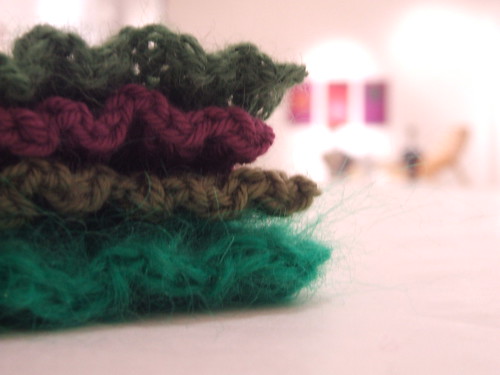
Stack of Tension Squares for Sun-Ray Ribbing

If you’re a member of the A Stitch in Time group over on Ravelry, you will know that we’re starting a Knit-Along (KAL) on Friday 8th January. We’re knitting the pattern Sun-Ray Ribbing from Susan Crawford and Jane Waller’s book A Stitch in Time. The garment is a lovely 1930s jumper with the quintessential sun-ray pattern, popular in design and architecture of the period. I’ve been knitting up tension squares to test out different yarns for the project over the past couple of weeks and after quite a bit of heartache ( more of which later) have come up with my final decision.

Swatches for Sun-Ray Ribbing

These are the same swatches as in the first photograph, above. You can see from this photograph the importance of making tension squares in deciding the final yarn and needle size to use. It really is essential to make sure that your square is knitted to the right size, as a little bigger or smaller at this size (generally 4 inches) could make a difference of one or even two sizes in your finished garment. The pattern instructions will ask you to knit a certain number of stitches and rows over a desired size. Below are my attempts to get the right tension, the right yarn and the right needles for this pattern.

The square top left is knitted in Rowan Cashsoft 4ply, as called for by the pattern. I used the suggested needles but as you can see, it came out rather too big, as I knit a little loosely. I had a number of other yarns to try out, and on the top right is the same yarn in a different colourway, knitted on needles a size smaller. It came out just right, but I’m not so keen on pink for this jumper and decided to keep it for a cardigan. I was set on a green so tried out some double knitting yarn that I had in my stash (bottom left) with the smaller needles, and while the density of the knitted fabric was better the tension square was much too large. My last attempt (and in all honesty the yarn that I really, really, really wanted to use) was with some Artesano Aplaca 4 ply. I knitted it up with the smaller needles again, but despite my best efforts to talk myself into using it, the tension of the fabric was really too loose and holey. It is a rather thinly spun 4ply in contrast with the much bouncier Cashsoft.

Bearing this in mind, and revisiting my stash yarns, I found that I had enough Sirdar Country Style DK in a warm mid-brown to make the jumper. It is a wool/nylon/acrylic mix which and I wasn’t sure if it would have enough spring to retain the shape of the garment as wool would, the tension square turned out quite well, so I’m going with it. Although my previous attempt swatching DK yarn turned out rather large, this is more thinly spun and similar to the American sport weight yarn. Using the smaller needles it actually knitted exactly to the right tension, so that is what I’ll be using.

Final tension square (middle)

There’s still time to join the Knit-Along for Sun-Ray Ribbing if you’re on Ravelry, and if you don’t fancy that pattern, we’ll be having another in April, so do join the group and get voting for your favourite pattern from A Stitch in Time and get your tension squares on the go.

Ingrid
editorial assistant

Labels: ,